Restumping in Ipswich
Restumping replaces the stumps holding your house off the ground — timber, concrete or steel — without necessarily raising the house any higher than it already sits. The contractor's price is set after someone looks under the house; Ipswich City Council's own fee to assess underpinning or restumping, where it is the certifier, is A$660. This page connects you with a QBCC-licensed local contractor.
Thanks — we have your enquiry. Someone will be in touch shortly. Prefer to talk now? Call (07) 3524 0616.
What restumping in Ipswich actually involves
The contractor's price turns on how many stumps are replaced and what is found under the house, which is why no figure is published here. The government side can be stated. Ipswich City Council's 2026-27 register of fees, effective from 1 July 2026, lists A$660 to assess underpinning or restumping where council is the building certifier, A$265 to lodge electronically and A$346 for each inspection. Where a private certifier is used instead, council still charges A$131 to lodge the application electronically. Building work valued over A$3,300 needs a QBCC licence, and residential construction work above that value needs home warranty insurance, which QBCC says pays up to A$200,000 and lasts 6 years and 6 months.
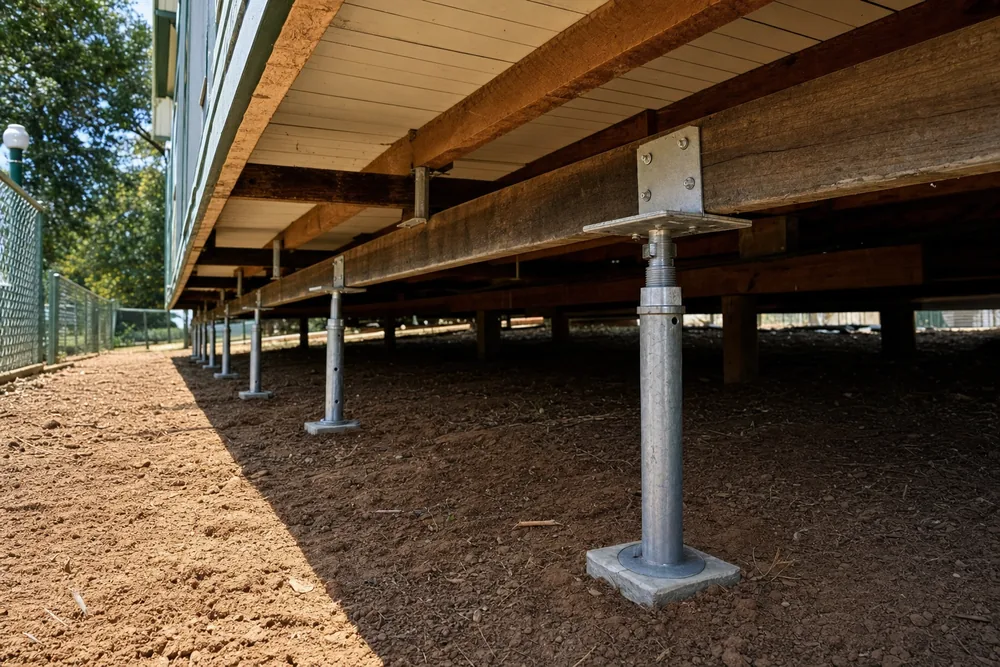
Restumping, raising and the ground under the house
A restump doesn't have to mean a full raise. Where a house has settled unevenly but the floor height is fine, stumps can often be replaced in place, correcting lean without changing how high the house sits. Where it needs to go higher, restumping and raising happen as one combined project instead (see the house raising page). The ground decides how long the new stumps hold: CSIRO's footing guide says most buildings that move are on clay, that clay swells as it takes up water and shrinks as it dries, and that the movement is not usually noticeable unless a rainy or dry spell runs for weeks or months. It says the site class, from A for stable sand and rock to E for extremely reactive, generally comes from a geotechnical report. A Queensland Transport and Main Roads study of the Ipswich to Springfield corridor maps soils there that include brown and grey uniform cracking clays.
The Bureau of Meteorology's Amberley station, listed 5.3 km from its Ipswich station, averages 857.3 mm a year over 1941 to 2026: 119.8 mm in December, 116.6 mm in January and 122.2 mm in February, against 27.7 mm in August. That wet and dry swing is the cycle CSIRO ties to clay movement. Note the months you see doors stick or gaps open and tell the inspector; age alone doesn't say which stumps have failed, and a contractor needs to get underneath the house to know.
What restumping costs in Ipswich
No contractor price is published for this job: it depends on the number of stumps and what the inspector finds. Ipswich City Council's 2026-27 register lists A$660 to assess underpinning or restumping (effective 1 July 2026, read 25 September 2026).
Sources, read 25 September 2026: Ipswich City Council, fees and charges 2026-27; CSIRO, foundation maintenance and footing performance; Transport and Main Roads, Ipswich to Springfield corridor study, land characteristics; QBCC, what is home warranty insurance.
The fees, thresholds and cost drivers that shape a quote are on the pricing page. A firm price comes from a site visit — call (07) 3524 0616 or use the quote form.
Restumping costs and rules check
Restumping in Ipswich — common questions
How is restumping different from house raising?
Restumping replaces the stumps holding the house up, which can be done at roughly the same height the house already sits. House raising means lifting the house higher than it currently is. The two are often done together, but restumping alone doesn't require a raise.
What does council charge to assess a restump in Ipswich?
Ipswich City Council's 2026-27 register lists A$660 to assess underpinning or restumping where council is the certifier, plus A$265 to lodge electronically and A$346 for each inspection. A private certifier sets its own fee, and council still charges A$131 to lodge a privately certified application electronically. We read the register on 25 September 2026; it applies from 1 July 2026.
How do I know if my house needs restumping?
Doors and windows sticking, visible floor slope, or gaps opening up between floor and skirting are common signs — but the only way to know which stumps have actually failed is a physical inspection underneath the house.
Suburbs we serve
Ready to get your restumping job quoted?
Free quote, one local provider, no obligation.
Last reviewed · Updated · First published